
Hunting for vintage furniture is a mix of curiosity, experience and a few trade secrets. Between a reproduction sold as an original and a genuine piece in beautiful condition, a handful of details often make all the difference. Here is a practical guide to recognising authentic vintage furniture before you buy, at a flea market or online.
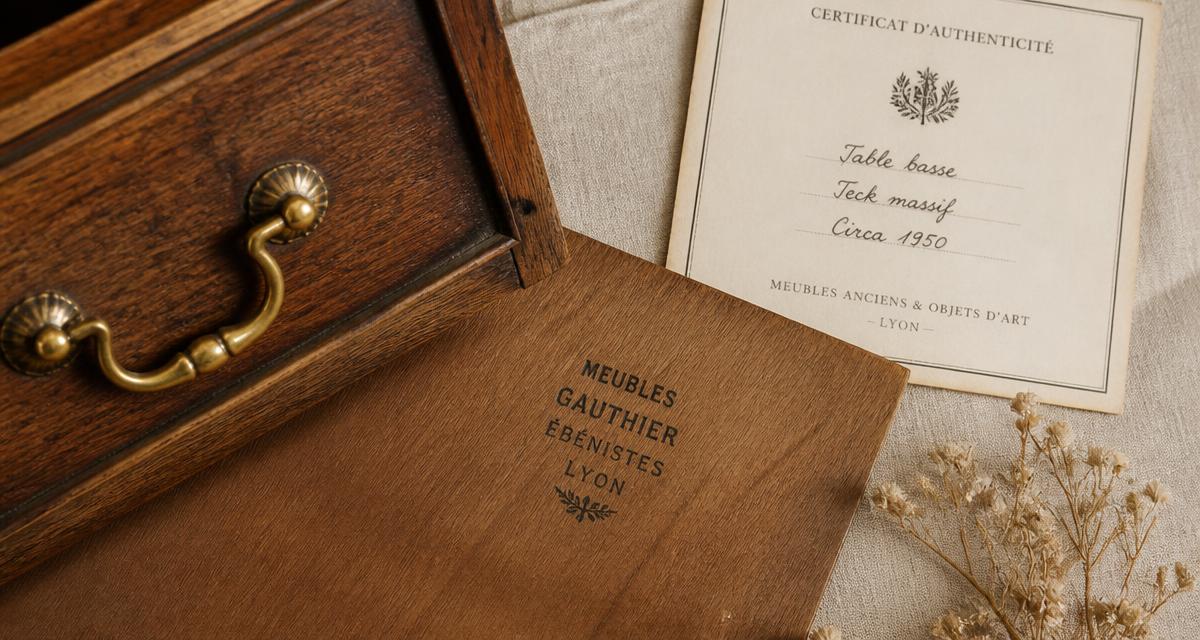
1. Materials and patina: the first clues
Solid wood is the first sign of a quality vintage piece. Before the 1960s, makers still worked with solid oak, walnut, beech or teak. A piece made of chipboard or MDF is usually from the 1980s onwards.
The patina tells the story of a piece. Slightly worn corners, old woodworm holes or uneven colour are good signs of authenticity. Be wary of a patina that looks too even — it has often been created artificially.
For metals, look for natural oxidation. Copper and brass develop a greenish or brown patina over time, while the chromed steel of the 1970s keeps its distinctive shine.
2. Maker's marks, stamps and signatures
Many 20th-century pieces carry a stamp, a plate or a maker's mark. French makers such as the Ateliers de Marolles, Huchers-Minvielle or prefabrication cabinetmakers often left their mark on the back or under a drawer.
Famous designers — Charlotte Perriand, Jean Prouvé, Pierre Guariche or the Castiglioni brothers — have recognisable signatures. Valuable pieces should be authenticated by an expert, as fakes are common.
Don't overlook mass-production labels: Formica, Baumann, Luterma, Steiner or MIM all left marks that help date a piece.
3. Construction techniques and joinery
Before furniture making became fully industrial, joints were cut by hand: dovetails, mortise and tenon, forged nails. These details reveal older craftsmanship.
Antique drawers are often assembled with round-headed nails and thin nailed bottoms. Wooden drawer runners, with no metal rollers, generally point to a piece made before 1950.
Veneers evolved too. Art Deco pieces use burr walnut, rosewood or Macassar ebony veneers, while the 1950s-1970s favoured teak, ash and coloured laminates.
4. Iconic French vintage styles
Art Deco (1920-1940): geometric lines, fine materials, lacquer and chrome. Look for symmetry, sharp angles and stylised motifs.
Scandinavian (1950-1970): light woods, clean lines, function first. Teak, ash and beech dominate, with tapered or compass legs.
Industrial (1950s-1980s): metal, raw wood, workshop patina. Farm tables, bistro chairs and printer's or workshop lockers are highly sought after.
Pop & Space Age (1960-1970): colourful plastics, rounded shapes, synthetic materials. Italian and French design from this era is very popular with collectors.
5. Pitfalls to avoid
New reproductions sold as originals: check for natural wear, smell (old wood, varnish) and hidden modern fixings.
Replaced parts: a rebuilt drawer, a replaced leg or a fully re-varnished surface lower the value. Ask for detailed photos and exact dimensions.
Pieces that look too perfect: a 50-year-old item always has small imperfections. A flawless surface may indicate a recent restoration or a copy.
Vague listings: a seller who won't specify the period, materials or condition deserves caution. Insist on a precise description and photos in natural light.
Timeline of the great vintage furniture periods
Dating a piece is the collector's first reflex: each decade has its own materials, shapes and signature legs.
1920-1940
Art Deco
Materials: Burr walnut, rosewood, lacquer, chrome
Tell-tale sign: Symmetry, sharp angles, precious veneers
1940-1955
Post-war
Materials: Solid oak, beech, painted metal
Tell-tale sign: Plain lines, sturdy build, few ornaments
1950-1970
Scandinavian
Materials: Teak, ash, beech
Tell-tale sign: Compass or tapered legs, oiled light wood
1950-1980
Industrial
Materials: Steel, raw wood, sheet metal
Tell-tale sign: Rivets, workshop patina, painted numbers
1960-1975
Pop & Space Age
Materials: ABS, acrylic, foam, laminates
Tell-tale sign: Rounded shapes, saturated colours
Authentic or reproduction? The comparison
Six criteria are usually enough to tell a period piece from a recent copy.
| Criteria | Authentic piece | Recent reproduction |
|---|---|---|
| Material | Solid wood (oak, teak, walnut) | Chipboard, veneered MDF |
| Joinery | Dovetails, mortise and tenon | Screws, dowels, metal brackets |
| Drawers | Wooden runners, nailed bottom | Metal roller slides |
| Patina | Uneven, worn at contact points | Even, simulated ageing |
| Hardware | Slotted screws, oxidised metal | Cross-head screws, bright steel |
| Smell | Old wood, wax, shellac | Glue, solvent, fresh varnish |
The 4-step inspection
In person or from photos, always work in the same order — it saves a lot of time.
1.Weigh it
A period piece is dense. A featherweight almost always means chipboard.
2.Turn it over
The underside and the back never lie: stamps, forged nails and repairs hide there.
3.Light it
Under raking light, patina, varnish touch-ups and tool marks show up instantly.
4.Ask
Period, provenance, restorations: a good seller answers precisely and sends detailed photos.
The savvy buyer's checklist
- Check the weight: an older piece is usually heavier than a chipboard copy.
- Inspect the joints: dovetails, mortise and tenon are good signs.
- Look for a mark, a stamp or a maker's label.
- Study the patina: it should be uneven and natural.
- Ask for photos from the side, underneath and inside the drawers.
- Compare prices: a deal that seems too good usually is.
When should you get an expert opinion?
For high-value pieces (signed designers, architect-designed furniture, collectibles), consult an expert or an auctioneer. A certificate of authenticity or an appraisal report protects your investment and strengthens resale value.
Frequently asked questions
What is the difference between vintage and antique furniture?
Vintage usually means a piece over 20 years old, typically made between 1920 and 1980. Antique refers to items over 100 years old, made before the industrial production of the 20th century.
How can I date a vintage piece with no maker's mark?
Cross-check three clues: materials (solid wood, veneer, laminate), joinery (hand-cut dovetails versus modern screws) and leg shape (compass legs in the 1950s-60s, tapered, tubular). Original hardware and screws are very telling too.
Should I restore a vintage piece before reselling it?
Gentle cleaning and waxing add value. A full strip-down or fresh varnish, however, erases the original patina and often lowers the value of a designer piece considerably.
How do I buy vintage furniture online with confidence?
Ask for natural-light photos from several angles (underside, back, drawers), exact dimensions, an honest description of flaws, and an insured delivery option for fragile or bulky pieces.
Ready to find your next vintage piece?
At Rajàa Broc, every item is carefully selected and honestly described. Browse our selection of vintage furniture, lighting and collectibles.
Visit the shop